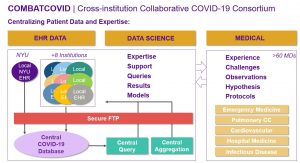
 As part of a consortium, Mount Sinai’s ConduITS, the Clinical Translational Science Award (CTSA) of ISMMS, supported by the National Center for Advancing Translational Science (NCATS), a division of the National Institutes of Health will offer as a resource to our investigators access to (N3C) and in the future the COMBATCOVID database a cross-institution collaborative.
The most ambitious effort in the United States is the National COVID Cohort Collaborative (N3C) database. The database is collecting information from electronic health records of patients who have been tested for COVID-19—whether those tests came back positive or negative—or who have reported COVID-like symptoms. Health care providers submit the records and NCATS makes them available for any credentialed researcher to analyze.
COMBATCOVID which is part of N3C and will bring together electronic health records (EHR) data from multiple participating institutions into a shared centralized database. As part of the COMBATCOVID effort, biospecimens data of COVID-19 patients collected by some of the participating institutions will also be shared and linked to the respective EHR data.
For further information for Mount Sinai researchers regarding the N3C data enclave and the COMBATCOVID consortium, please contact: Anar Poltinnikov at: Anar.Poltinnikov@mountsinai.org
Study Purpose
The purpose of this study is to create a data registry of all inpatients and outpatients across all participating centers from January 1, 2020 to December 31, 2022 in order to further understand and characterize illness due to the novel coronavirus (COVID-19 disease).
Primary Objective
To establish an active data registry of patients across health institutions and partnered Clinical Research Networks (CRN) to gather data on COVID-19 related symptomology, comorbidities, risk factors, diagnoses, clinical findings and outcomes.
Data Source
Data sets from participating health centers and other CRN (Clinical Research Networks) will be shared with NYU Langone Health and uploaded into a central data registry maintained by NYU Langone Health (on site).
ConduITS is supported by NCATS of the NIH’s CTSA Program. Any use of CTSA-supported resources requires citation of grant number UL1TR001433.