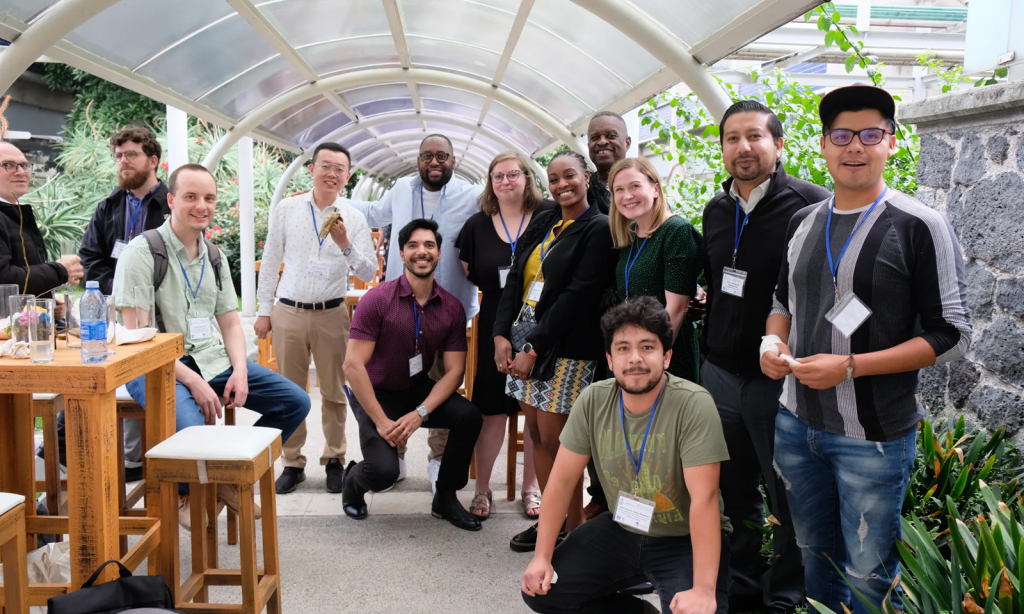
In 2025, the Exposomics Core was a part of multiple events, including:
Lunchtime Chat Webinars (held throughout the year)
On January 8, 2025, Maayan Yitshak-Sade, PhD, MPH (Associate Professor, Department of Environmental Medicine, Icahn School of Medicine at Mount Sinai), shared her research on environmental risk factors for stroke, focusing on temperature, greenness, and air pollution. Dr. Yitshak-Sade is an environmental epidemiologist investigating the complex health effects of exposure mixtures and their impacts on morbidity, mortality, and life expectancy across various demographic and socioeconomic population groups in the United States. A recording of the event can be found here.
2025 CME Conference (March 14, 2025)
Held at the Icahn School of Medicine at Mount Sinai, this CME conference focused on “Preparing for Patient Care During Environmental Extremes.” This event aimed to equip healthcare professionals, trainees, and researchers with the knowledge and tools to address the increasing impacts of environmental extremes on patient care through presentations from physicians and professors, panel discussions, and poster sessions.
2025 Santiago Exposome Symposium (September 25 – 27, 2025)
Supported in part by the National Institute of Aging (R13AG087672) and in partnership with the Brookdale Department of Geriatrics, they hold an international symposium on exposomics annually. Over 100 scientists, clinicians, and trainees from around the world gathered in Santiago, Chile, for the Second Latin American Exposome Symposium to discuss how environmental exposures influence brain health and aging. Organized in part by faculty from the Institute for Exposomic Research and the Brookdale Department of Geriatrics and Palliative Medicine at the Icahn School of Medicine at Mount Sinai, the symposium featured 28 expert talks and 27 poster presentations. Information on previous Exposome Symposiums held worldwide can be found here.
The Institute for Exposomic Research also hosts Ground Round events, which can be found here. Topics covered in previous Grand Rounds include:
Leveraging Machine Learning to Analyze Social Determinants of Health and Their Association with Health Outcomes in California: A Focus on Obesity and Diabetes Outcomes (November 12, 2025)
Alexandra Descarpentrie, PhD (Postdoctoral Fellow in the Goran Laboratory at Children’s Hospital Los Angeles) explored how machine learning can be applied to analyze social determinants of health and their associations with various health outcomes in California, with a particular focus on obesity and diabetes outcomes. By using publicly available data, her research investigates how factors such as neighborhood environments, socioeconomic status, and healthcare access may affect health outcomes. Her presentation demonstrated how interpretable machine learning models can reveal complex relationships and trends within these determinants, offering valuable insights for policymakers to address health disparities and improve public health strategies. A recording of the presentation can be found here.
Hidden Toxins? Mycoestrogens Exposure in Early Life (November 19, 2025)
Zorimar Rivera-Núñez, PhD (Assistant Professor in the Department of Biostatistics and Epidemiology at the Rutgers School of Public Health) discussed mycotoxins, which are toxic chemicals produced by fungi that can contaminate grains and enter the food supply. Among them, mycoestrogens are particularly concerning because they mimic estrogen and may disrupt hormonal regulation during sensitive windows of development. Dr. Rivera-Núñez aims to understand how these chemicals affect fetal growth, infant development, and placental function to refine exposure assessment, identify critical windows of susceptibility, and provide evidence that can guide policies and interventions to protect maternal and child health. A recording of the presentation can be found here.
Some upcoming events in 2026 include:
Spring 2026 Environment and Health Webinar Series (February – June 2026)
Scientists at the Icahn School of Medicine at Mount Sinai are advancing research that reveals how environmental exposures shape health across the lifespan. Through this webinar series, we translate discovery into action – connecting groundbreaking science to real-world solutions that empower families and communities to make informed choices and improve long-term health outcomes. This series is organized by the Institute for Exposomic Research and the Center on Health and Environment Across the LifeSpan (HEALS). Learn more and register.
2026 Exposome & ADRD Symposium (June 17 – 19, 2026 in Bordeaux, France)
Convening leading scientists and trainees in exposomics and neurogenerative diseases, the symposium will advance the integration of environmental exposures into Alzheimer’s Disease and Related Dementias (AD/ADRD) research. The meeting is organized by the Institute for Exposomic Research and the Brookdale Department of Geriatrics and Palliative Medicine at the Icahn School of Medicine at Mount Sinai, the University of Bordeaux, and INSERM, with additional partners including EIRENE, IHEN, NEXUS, and GECC, and is supported by multiple NIH grants. Learn more and register.
The Exposomics Core will hold various other events in 2026, which will be promoted on the ORS research mailing lists and on their website. You can also find more information regarding upcoming events on the Mount Sinai Exposomics page and the Mount Sinai Department of Environmental Medicine events page. Stay tuned!
ConduITS is supported by NCATS of the NIH’s CTSA Program. Any use of CTSA-supported resources requires citation of grant number UL1TR004419 awarded to ISMMS in the acknowledgment section of every publication resulting from this support. Adherence to the NIH Public Access Policy is also required.