 Jordyn Feingold, a student in the PORTAL program (MD/MSCR), is currently pursuing her Scholarly Year of Research, funded by our ConduITS CTSA TL1. A graduate of the University of Pennsylvania she holds a Masters in positive Psychology and is deeply committed to investigating the potential clinical impact of the principles in health and disease as evidenced by recent scholarly review on the role of cognitive behavioral therapy and positive psychology for for digestive disorders (J Clin Gastroenterol 2019; 53: 477-485).
Under the mentorship of Laurie Keefer, PhD, her project entitled “Empowered Transitions: Understanding the Experience of Transitioning from Pediatric to Adult GI Care in Adolescents with IBD and Their Parents Using Photovoice” uses mixed methods research to better discern the barriers and facilitators of successful transitions of care for adolescents with IBD and their parents.
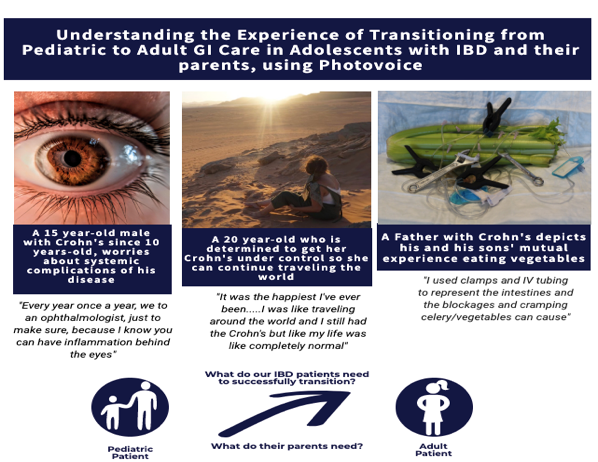 To best capture her project, Jordyn developed an infographic that reflects the conceptual framework and provides inspiration for her project. Inflammatory bowel diseases (IBDs) that include Crohn’s disease and ulcerative colitis, are chronic intestinal disorders most often diagnosed in adolescence and young adulthood. Adolescents with IBD are vulnerable to poorer outcomes and higher health costs, partially attributed to disruptions in the continuity of care in the shift from pediatric to adult care settings. Disruptions in care may be due to subtle differences in the paradigms of pediatric verses adult IBD care, poor adolescent self-management skills, non-adherence to medications, low attendance in ambulatory care clinics, and other factors. Additionally, there is presently no universal consensus among providers about the timing of initiation and completion of the transition process for adolescents and young adults with IBD, and access to structured pediatric transition readiness programs are lacking, with a paucity of research to evaluate relevant clinical outcomes in such existing programs. The impact of this study should provide keen insights into behavioral approaches for this clinically relevant unmet need and serve ultimately facilitate better outcomes for this unique and vulnerable population.